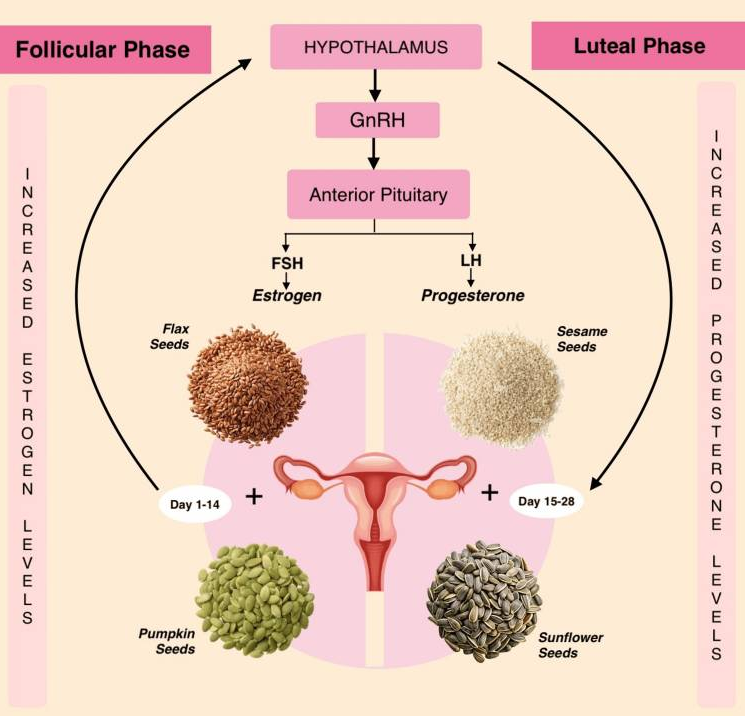
Adapted from Mahapatra et al.Seed cycling is a simple food practice built around the idea of eating different seeds during different phases of the menstrual cycle.
The usual rhythm:
~ flax + pumpkin seeds during the first half of the cycle, (Follicular phase, from the first day of your bleed to ovulaion)
~ sesame + sunflower seeds during the second half, (Luteal phase, from ovulation to the day before your start the cycle again.)
The thinking is that the different nutrients and plant compounds in these seeds may support the body's changing hormonal rhythms.
Is it proven? Not quite. Since seeds aren’t a patentable treatment, there’s considerably less financial incentive to fund research into their effects. However, seeds themselves are wonderfully nutritious foods whether or not your hormones are paying attention, and what works for your individual body is really the only research result that matters.
How do I know it’s working for me? Because I experimented, and I noticed, and I journaled. It took some time before I realized that the complaints I’d journaled about my cycle symptoms were no longer a concern. (In fact, it wasn’t until my symptoms returned after I stopped seed cycling that I even remembered they were a thing!) I can only encourage you to experiment with what feels right. See what works for you.
Still looking for data? (As a scientist, I always do.) I've gathered some of the research and resources below so you can explore for yourself.
Resources
Mahapatra, Baro & Das (2023) — Advantages of Seed Cycling Diet in Menstrual Dysfunctions: A Review-Based Explanation — a review of the theory behind seed cycling and the nutritional properties of the four seeds. The authors themselves note that stronger scientific evidence is still needed.
Nagarajan et al. (2025) — Efficacy of Seed Cycling as an Integrative Therapy for Premenstrual Syndrome and Polycystic Ovary Syndrome in Reproductive-Aged Women: A Systematic Review — a more recent review of the clinical research, including what we know, what looks promising, and where the evidence is still thin. It's openly available under CC BY 4.0